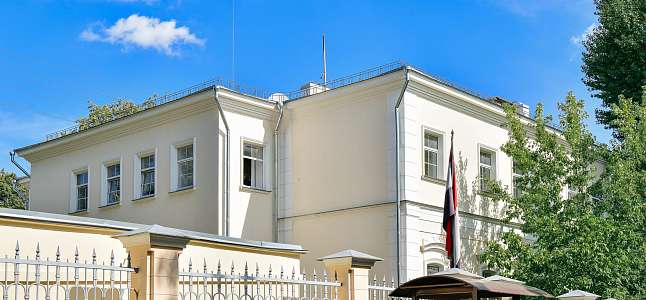
Yeropkinsky Lane, Building 5
Yeropkinsky Lane, connecting two major Moscow thoroughfares – Prechistenka and Ostozhenka – takes its name from the surname of General-in-Chief and Senator Pyotr Dmitrievich Yeropkin. This cozy street in the heart of the capital still retains its appearance from the late 19th and early 20th centuries.
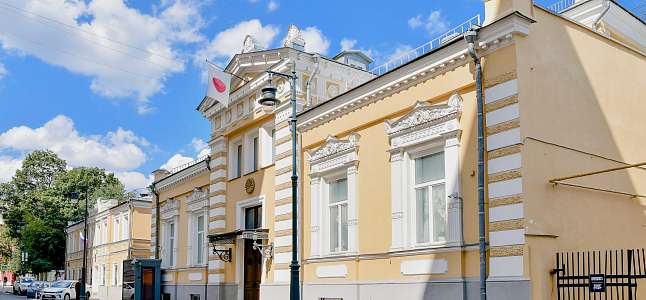
A well-preserved example of that era is the four-story yellow-and-red building, now numbered 5, designed by architect Pyotr Pavlovich Shchekotov. The turn of the century saw the architect's active work in Moscow (apartment buildings and commercial buildings throughout the city), the Moscow Province (the Pottery Factory in Pavlovsky Posad and the Karmanov Paper Mill in Podolsk District), and Crimea (the A.V. Krivoshein Sanatorium in Miskhor). The four-story apartment building on Yeropkinsky Lane, commissioned by Court Councilor A.T. Yerofeyev in 1902, is one of Shchekotov's most striking works. The artist fully utilized his preferred method: combining large-scale decoration with a rational façade structure.
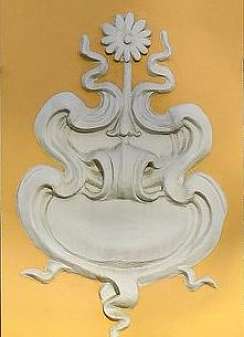
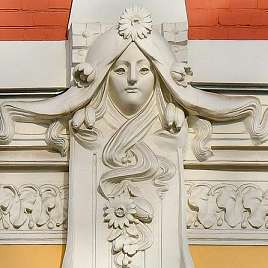
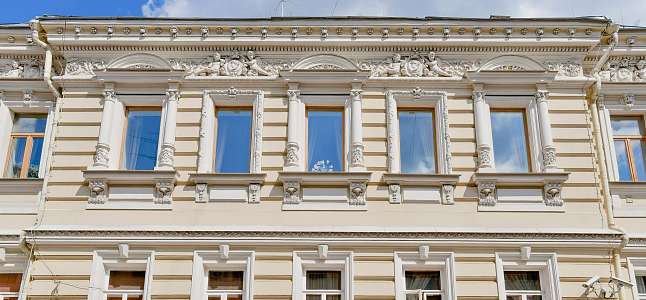
Its multi-colored paintwork is striking: the upper half is dark red, the lower half yellow, with white window frames. Particularly striking is the rather narrow central section (above the entrance) with its powerful side projections (at the level of the two upper floors) and asymmetrically positioned windows (relative to the rest of the façade). Above the first- and second-floor windows, as well as beneath the cornice, stretch bands of stucco floral patterns. But the most memorable part of the decoration is the female heads, corresponding to the typical image of Lorelei, a nymph or Rhinemaiden from Germanic folklore. She was traditionally depicted with flowing mermaid-like hair, half-closed eyes, and a barely perceptible smile. The composition is completed by botanically accurate iris flowers with detailed depictions of the leaves, stems, and roots.
The building is currently under the jurisdiction of the GlavUpDK.
GlavUpDK uses cookies and similar technologies to operate the site and personalize content, as well as to improve your experience with the site, marketing activities and collect statistics.
By clicking the "Accept all" button, you agree to the storage of cookies on your device and cookie analytics by GlavUpDK under the Ministry of Foreign Affairs of Russia. You can disable cookies in your browser settings. Depending on the settings you choose, the site or its personalized functionality may become unavailable.
GlavUpDK uses cookies and similar technologies to operate the site and personalize content, as well as to improve your experience with the site, marketing activities and collecting statistics
 Sites GLAVUPDK